Charles Starkweather
The jacket that started this piece.
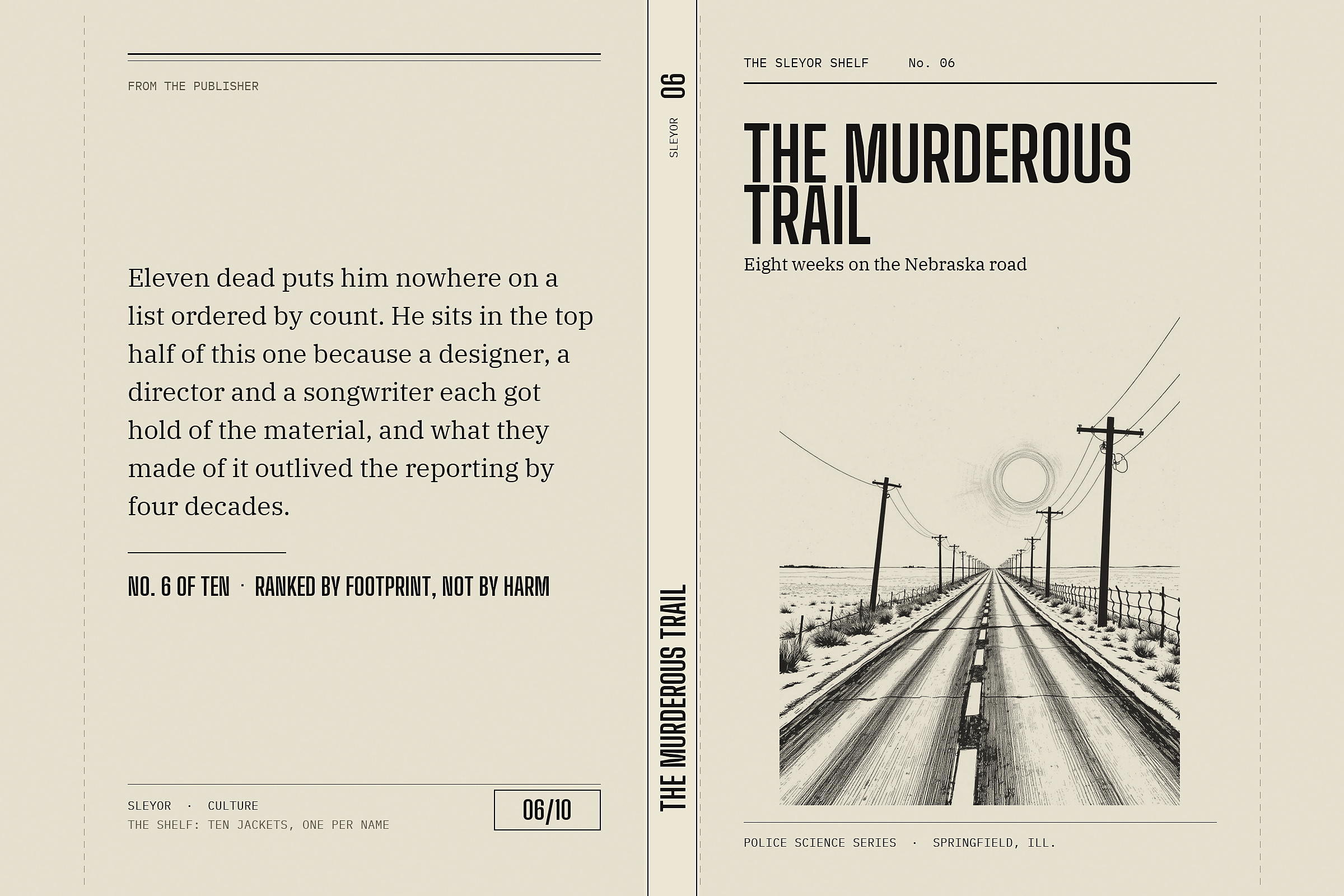
- Eleven dead across Nebraska and Wyoming over eight weeks in the winter of 1957–58, with fourteen-year-old Caril Ann Fugate alongside him — her own culpability contested to this day. Executed 25 June 1959.
- His criminology professor, James Melvin Reinhardt, published 'The Murderous Trail of Charles Starkweather' in 1960 with Charles C. Thomas of Springfield, Illinois, in its Police Science Series.
- Terrence Malick's 'Badlands' (1973) is loosely based on the spree, and the title track of Springsteen's 'Nebraska' (1982) is about him — a record Springsteen considered calling 'Starkweather'.
A university press cover, and two pieces of American art.
On any count-based list he does not place at all. On this one he is top six, because he generated a body of American art no one else here comes close to.
The 1960 monograph is the exhibit. A police-science jacket, a scratchboard skeleton, the state dotted in behind it — somebody sat down and designed him, and the design outran the case within a decade.
Every plate in this series is drawn in that idiom, because that jacket is the argument.
Starkweather killed eleven people between December 1957 and January 1958, was accompanied by fourteen-year-old Caril Ann Fugate, and was executed on 25 June 1959.
Encyclopaedia entry, 'Charles Starkweather'retrieved 2026-08-14
James Melvin Reinhardt's 'The Murderous Trail of Charles Starkweather' was published in 1960 by Charles C. Thomas, Springfield, Illinois, in its Police Science Series.
Antiquarian bookseller listing, AbeBooksretrieved 2026-08-14
'Badlands' (1973) is loosely based on the Starkweather murder spree.
Encyclopaedia entry, 'Badlands (film)'retrieved 2026-08-14
Springsteen's 'Nebraska' (1982) is about Charles Starkweather, and 'Starkweather' was considered as the title.
Songfacts, 'Nebraska' by Bruce Springsteenretrieved 2026-08-14
The full argument is filed in the anchor piece, and the index to all ten jackets is here.